Team leads and facilitators
Run the five stages of Map Your Leadership Environment
How the five stages fit together, what each session needs, and where the team's decisions are made.
- Time to allow
- Two to three facilitated sessions of about 60 minutes
- Who can do this
- The person leading the alignment, with the team present
Before you start
- Enough of the team has completed the diagnostic to meet the threshold on the stage rail.
- Informed team consent has been given.
How the stages fit together
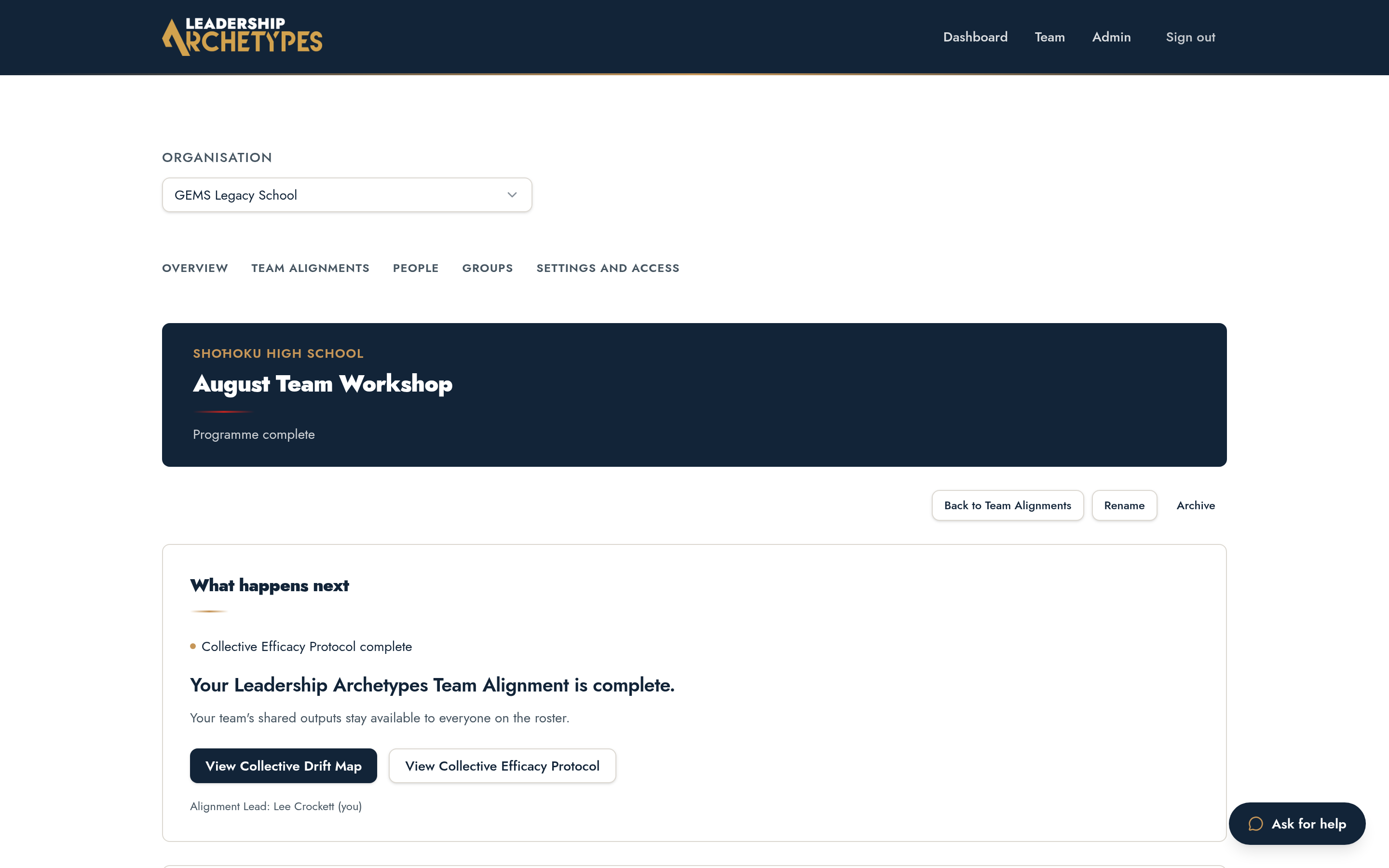
The five stages move from what the team prefers, to what it actually enacts, to what happens between people, to what changes under pressure, and finally to the Collective Drift Map the team approves.
Stages open in order and stay open. You can revisit a stage in a later session without losing anything the team confirmed.
- 1
Stage 1 — See the team's signature.
Result: The team recognises its own shape.
- 2
Stage 2 — See our behavioural coverage.
Result: Two or three consequential insights the team agrees are real.
- 3
Stage 3 — Interaction dyads.
Result: Named dynamics between orientations.
- 4
Stage 4 — Drift.
Result: The movement the team wants to change.
- 5
Stage 5 — The Collective Drift Map.
Result: A team-approved publication.
How to split the sessions
Stages 1 and 2 sit well together in one session: the team sees itself and then sees the consequences. Stage 3 and 4 form the second session, where the conversation gets harder. Stage 5 is best kept separate so the team reads the map with fresh attention.
Facilitating each stage
Every stage follows the same rhythm: look at the visual, name what the team sees, read the drafted reading, edit it into the team's own words, confirm.
Facilitate patterns, not people. Nothing in these stages is an individual result, and no individual answers are visible to anyone.
If the team cannot agree a statement, record the disagreement in the wording rather than forcing consensus.
What good looks like
- Every confirmed statement is in the team's language.
- The team can name two or three things it wants to change by the end of Stage 4.
If something goes wrong
- A stage is locked.
- Check the stage rail: it names what is outstanding — completions, consent, or the previous stage's confirmation.
- The visuals feel abstract to the team.
- Start with a concrete recent example and ask where it would sit on the visual.