
Team leads and facilitators
Environment Stage 2 — See our behavioural coverage
Separate what the team is pulled towards from what it actually does, and surface the insights that carry consequences.
- Time to allow
- About 35 minutes
Before you start
- Stage 1 confirmed.
Read the coverage field
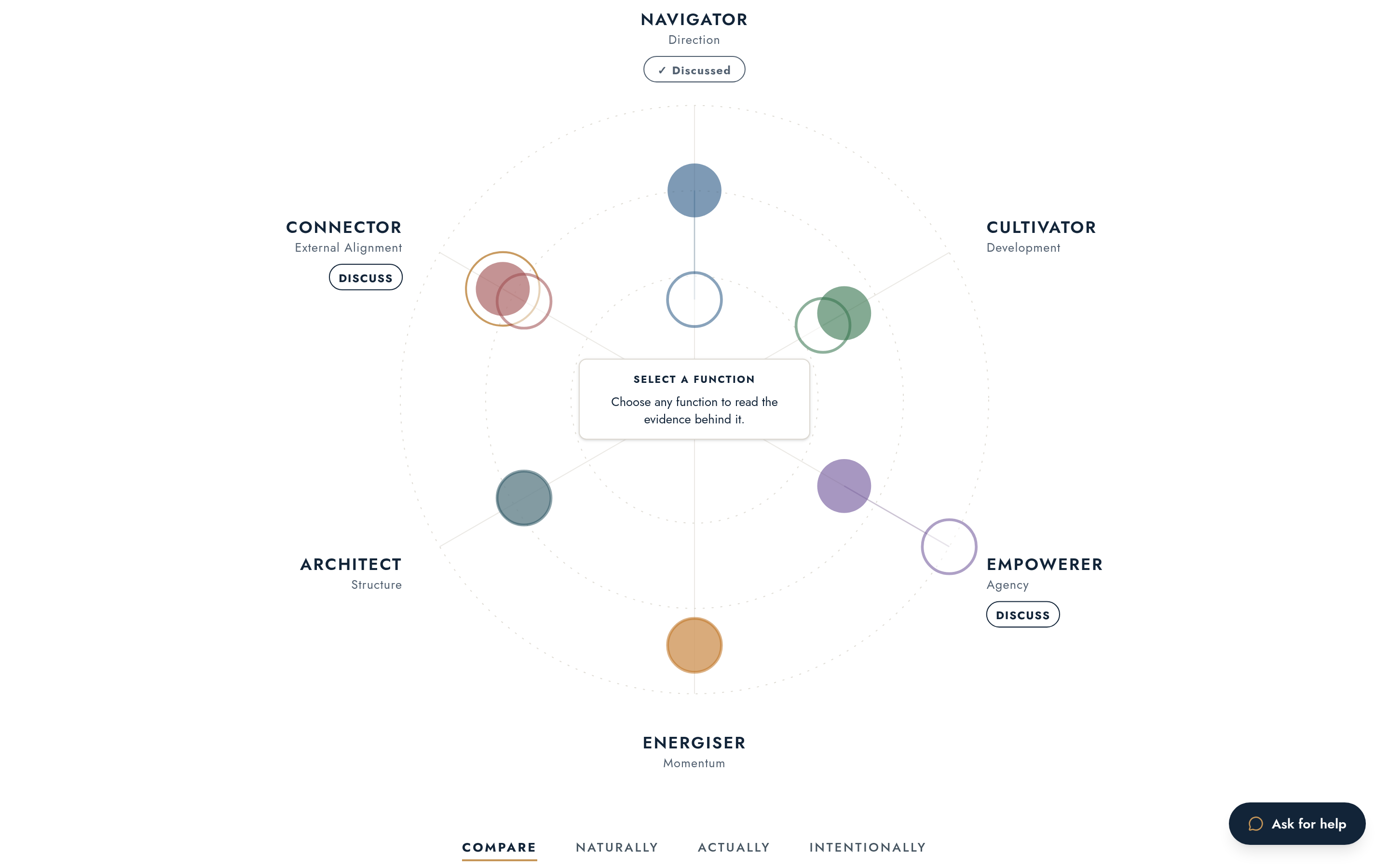
The coverage field shows natural pull against enacted practice for each behavioural function. Where the two diverge, the team is doing work that does not come naturally — sustainable for a while, rarely for long.
Thin coverage means nobody enacts a function. Concentrated coverage means one or two people carry it alone. They need different responses: thin coverage needs a decision about who takes it; concentrated coverage needs relief.
Run the stage
- 1
Open Stage 2 and read the coverage field with the team.
- 2
Work through the surfaced insights one at a time.
The stage surfaces the two or three with consequences rather than listing every function.
- 3
For each, ask what it costs the team today.
Keep it to observable cost: rework, delay, someone carrying too much.
- 4
Read the synthesis at the end and edit it.
The synthesis comes last on purpose — after the team has done the thinking.
- 5
Confirm the stage.
Result: Stage 3 opens.
What good looks like
- The team can name who is currently carrying a concentrated function.
- Thin coverage is treated as a decision to make, not a fault to explain.
If something goes wrong
- The team disputes the coverage reading.
- Good. Ask for the counter-example and edit the wording to include it — the map should describe the team, not the model.